Wall rendering
Wall rendering in Harrogate
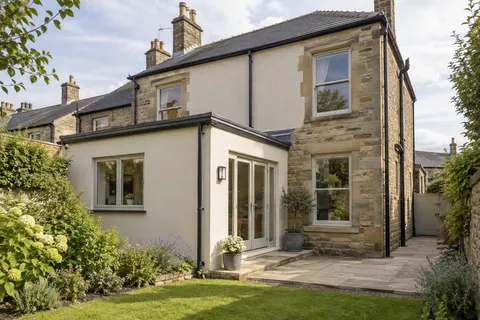
Wall rendering covers one elevation rather than the whole house: a weathered gable, the side return of a semi, a rear outrigger or the wall of a new extension. The work on the wall itself matches a full re-render. What makes a single wall different is where it stops, because every edge of the new render meets something that is staying: older render, brick, a stone quoin or a neighbour’s wall.

On this page
Why one wall gets done on its own
Gables and side walls take the weather differently from the front. A tall gable catches driven rain across its whole face, and the render on it can crack and loosen years before a sheltered front does. Rear outriggers often carry later repairs around altered windows and soil pipes. An extension may be new blockwork that has never been rendered. Each is a reason to treat one wall and leave the rest of the house alone.
Tap the wall before deciding. If the hollow areas are scattered patches, a render repair may be enough. If most of the face sounds dull and hollow, or cracks have opened into a map of loose plates, the whole wall is usually better taken back to the brick.
- Set the edges Decide where new render stops against brick, stone or an existing finish.
- Prepare the background Remove loose material, repair masonry and prepare suction and surface key. Existing paint needs a specified removal or alternative treatment.
- Base coat Built up to level the wall, with mesh where backgrounds change or crack.
- Finish Matched to the rest of the house or chosen as a deliberate contrast.
- Shed the water Copings, sills and the base bead keep rain off the top and away from the bottom edge.
The usual order of work. The survey and the chosen products decide the actual steps.
How a single wall is taken back and rebuilt
With scaffold or a tower in place, the old render is cut along the line where the new work will stop, usually with a disc, so the render that stays keeps a clean, square edge instead of cracking back unevenly. The rest is hacked off. The bare wall is brushed down, loose mortar raked out, and cracked bricks or old fixing holes made good.
New blockwork is left to dry and settle first, and the base coat itself needs time: K Rend’s Silicone TC data sheet asks for a base coat to stand at least 14 days before primer and topcoat. K Rend also says alkali-resistant mesh must be bedded into its HP12 base coat at stress points such as door and window reveals, which is where diagonal cracks usually start.
Mark the stopping lines at corners, stone and adjoining render.
Cut the retained render to a straight edge and hack off the rest.
Rake out and repair brickwork; let new blockwork dry.
Fix corner, stop and bell-cast beads to line and level.
Apply the base coat with mesh at openings, then the finish coat.
Texture and colour to the agreed sample; protect while it cures.
Where the new render stops
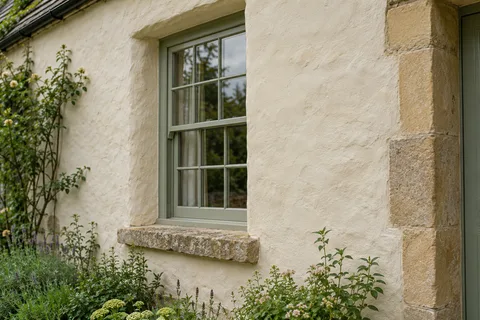
At an external corner the render runs round onto the next wall and finishes on an angle bead, or stops on a stop bead set just round the return so the joint is hidden from the main view. Where the wall meets bare sandstone, such as a quoin or a stone window surround, the render stops on a straight bead line and never laps onto the stone. Where it meets retained render on the same plane, the joint works better at a downpipe, a corner or a change in the wall than in the middle of a flat face, where it will always show.
At the base, the render finishes on a bell-cast bead just above the damp-proof course. At the top of a gable it tucks under the verge or bargeboard, and that joint has to shed water rather than collect it.
Matching the wall to the rest of the house
A new wall beside old render rarely disappears. The old surface has weathered, collected dirt and may have been painted several times; the new one starts clean. Through-coloured renders can also vary slightly: K Rend notes that, because its products use natural materials, slight shade variations may occur. A painted finish gives the most control, because once the new wall has cured the whole elevation, or the whole house, can be painted one colour.
Texture matters as much as colour. A smooth floated wall next to an older roughcast one reads as a patch whatever the paint. Take a sample board to the wall itself, look at it when low sun rakes across the gable, and decide whether you want a close match or a deliberate change at a corner.
Permission and protection
In a conservation area, rendering brick or stone that was never rendered, or changing to a different finish, alters the building’s appearance; the government’s technical guidance says cladding with render is not permitted development there. Whether like-for-like renewal of existing render needs permission depends on the work, so check the actual proposal with North Yorkshire Council. After application, the new wall needs the same care as a whole house: sheeting against rain, shade from strong sun and no work when frost is due.
Common questions
Will the new wall match the old render?
Rarely exactly. Weathering, dirt and earlier paint change the old surface. A finish painted after rendering, or a joint placed at a corner or downpipe, gives a better result than trying to blend new render into old in the middle of a wall.
See housing and planning information for Harrogate and nearby places, including the source and geography behind each figure.