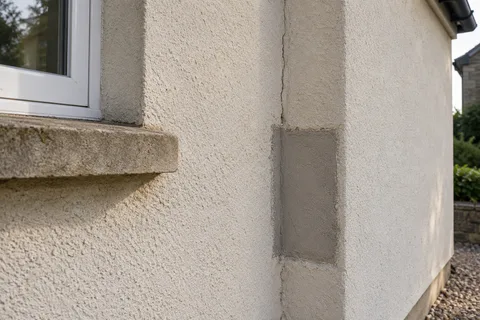
Render repair
Render repair in Harrogate
A render repair replaces the parts of a wall’s render that have cracked, lost their grip or fallen off, and leaves the sound render in place. It suits walls where the damage is local: a hollow patch under a bay, cracks running from a window corner, a strip blown by frost along the base. When the hollow areas join up across most of the wall, a wall re-render is usually the better job.

On this page
Finding out how much is loose
Tendring District Council’s conservation guidance puts it simply: the extent of repair is found by tapping the surface, because render that has detached from its backing sounds hollow and may feel loose, and only the minimum should be taken off. The tap test covers the damaged area and well beyond it, and the hollow zone is chalked on the wall before any cutting starts. The marked area is often bigger than the visible crack.
Cracks tell you different things. Fine crazing in the surface is common and often cosmetic. A crack running diagonally from a window corner usually follows stress at the opening. A crack that is widening, steps through the masonry or reappears after repair may come from movement in the wall itself, and needs a surveyor or engineer to look at it before it is patched.
Bays and porches are frequent trouble spots on Harrogate houses because the render there wraps round corners, meets timber and lead, and sits under projecting roofs that drip onto it. Expect to find hollow render where the bay roof flashing or a sill has let water in.
- Map the damage Tapping finds hollow areas; cracks and their likely cause are noted.
- Cut back Failed render is cut out to a sound edge, usually squared off.
- Fix the cause Leaking gutters, sills without drips or render below the DPC are dealt with.
- Rebuild in coats Using a material compatible with the surrounding render and masonry.
- Blend the finish Texture is matched; colour may need a coating over the wider area.
The usual order of work. The survey and the chosen products decide the actual steps.
When the wall looks damp
Where a rendered wall looks damp, the render can be part of the cause. A crack lets rain in and a dense render then stops it drying out. Render taken down past the damp-proof course to the ground can carry ground moisture above it. A leaking gutter or downpipe soaks one strip of wall again and again; SPAB’s advice on rainwater fittings is to keep them clear and in good repair. Fixing the render and the water source together deals with the render-related problem. Internal damp treatments are a separate trade and are not covered here.
How a patch is made
The hollow area is cut back to sound render with straight sides, so the repair has a firm, square shoulder to finish against instead of a crumbling feather edge. Loose material is removed down to the masonry, which is brushed clean and dampened or primed to control suction. The patch is then built up in the same number of coats as the original, each keyed, to finish flush with the surrounding surface. Lime render is repaired with lime; Tendring’s guide adds that small repairs to cement render should use cement of similar density and strength, because lime in a cement wall cracks again.
Tap-test and chalk the hollow and cracked areas.
Cut back to sound render with clean, straight edges.
Remove loose material and clean the exposed masonry.
Dampen or prime the background to suit the repair material.
Build up the patch coat by coat to match the original.
Texture to match, then paint or coat once it has cured.
Matching the patch
A patch nearly always shows at first. New render is cleaner and a slightly different shade, and texture is hard to copy, especially an old roughcast. Painted walls are the easiest to repair invisibly, because once the patch has cured the whole elevation is repainted. Through-coloured renders can be patched in the same product, but the new work will look fresher until it weathers. Next to Harrogate’s stone surrounds and bays, the repair should stop at the stone, not be smeared over it.
For fine cracks, a flexible exterior filler such as K Rend’s Colour Fill is meant for small cracks and holes in render. It is not a fix for a hollow area behind the crack.
Keeping repairs small
Look over the render each autumn: along the base, under sills and around downpipes, where water concentrates, and tap anything that looks bulged. A crack dealt with before winter is a smaller job than the hollow patch frost can make of it. If repairs keep recurring in the same place, the cause is usually something feeding water to that spot.
Common questions
Can a crack just be filled?
A fine surface crack in otherwise sound render can be filled with a flexible exterior filler and painted. If tapping shows the render around the crack is hollow, filling only hides the problem; that area needs cutting out and re-rendering.
See housing and planning information for Harrogate and nearby places, including the source and geography behind each figure.