Render resprays and colour changes
Render resprays and colour changes in Harrogate
A render respray is a colour change: the existing render stays, it is cleaned and repaired, and a coating made for masonry is sprayed onto it. It suits render that is sound but faded, stained or the wrong colour. It is not a repair for hollow or cracked render, and in parts of Harrogate a new colour needs permission before it needs a sprayer.

On this page
The Article 4 painting direction
Harrogate Borough Council made an Article 4 direction in December 2005 for the town’s conservation area. As the 2010 appraisal describes it, the direction brings two kinds of work within planning control: painting any previously unpainted external fabric, and repainting previously painted fabric in a different colour, with joinery and metalwork excepted. The appraisal says painted façades have detracted from the town’s character and, for the Duchy Estate, lists painting of façades or details such as stone surrounds among changes that spoil pairs of semis. Check the current schedule with North Yorkshire Council for your address.
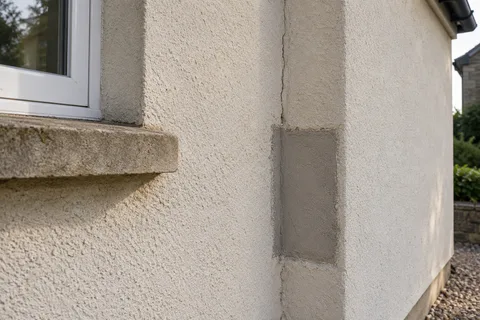
Repainting in the same colour is treated differently from changing colour, and coating bare stone is a far bigger step than recolouring render. Keep sandstone surrounds, sills and quoins uncoated unless a permission says otherwise.
- Clean Washed down, with algae and mould treated and left to work.
- Repair first Cracks and hollow patches are repaired before any coating.
- Prime or stabilise Where the coating maker requires it on that surface.
- Coating Usually two coats of a breathable masonry or silicone coating.
The usual order of work. The survey and the chosen products decide the actual steps.
Is the render good enough to spray?
A coating is only as sound as the surface under it. Tap the render first: hollow areas must be cut out and patched. Fine cracks are filled; wider ones are opened up and repaired. Flaking paint has to come off. Repaired patches are left to cure before spraying, or the coating can show them as darker or shinier areas.
Look at where the staining is before choosing a colour. Dark streaks below sills and copings usually mean their drips have failed, and green patches often sit under a leaking gutter or beside a tree. Fix those first, or the new colour will mark in exactly the same places within a year or two.
What happens on the day
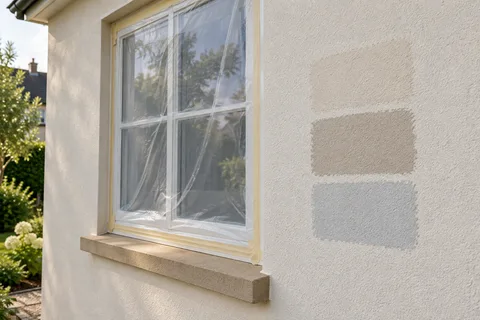
Everything that is not being coated is masked, because spray drifts: windows, doors, stone dressings, sills, roof edges and paths. The walls are washed and treated with a biocide to kill algae and lichen, rinsed and left to dry. A primer or stabiliser goes on where the surface is powdery or patchy, and the colour follows, usually in two coats. Spraying lays an even film and gets into textured render quickly; edges are cut in by brush.
Tap-test and repair hollow or cracked render; let patches cure.
Mask windows, doors, stone dressings, sills and paths.
Wash, apply biocide and rinse; let the wall dry.
Prime or stabilise powdery or patched areas.
Spray the first coat, then the second once it is dry.
Remove masking and touch in edges by brush.
Choosing the coating
The coating has to suit the render. On modern sand-and-cement or through-coloured render, silicone masonry paints are common; K Rend describes its version as combining silicone resin and mineral fillers for water repellence, and makes a separate coating, Colour Enhance, for refreshing existing scraped render. On lime render, SPAB recommends limewash, because standard masonry paints are less permeable and can trap moisture in an older wall. Painting a through-coloured render commits you to repainting it in future.
Choose colours outside, on the wall itself. The appraisal notes that most of the town’s stone buildings have never been cleaned and read as a sombre grey; a shade that looks warm on a chart can look quite different beside them and the Welsh slate roofs, and any colour reads lighter across a whole elevation.
Building regulations, weather and upkeep
A decorative coating does not count as renovating a wall: the Planning Portal says renovation for building regulations excludes decorative finishes, so a respray does not bring in the thermal upgrade rules that can apply to re-rendering. Coatings carry their own weather limits, usually a minimum temperature and no rain until they are dry. Afterwards, wash the walls gently when green growth appears and touch up chips with the same product.
Common questions
Does a respray fix cracked render?
No. A coating can bridge hairline crazing, but cracks and hollow render need repairing first. Spraying over them hides the problem for a season or two before it shows again.
Can through-coloured or monocouche render be resprayed?
Yes, with a coating made for it, such as the products some manufacturers sell for existing scraped render. The wall then becomes a painted surface, so plan on recoating it in future rather than relying on the colour in the render.
See housing and planning information for Harrogate and nearby places, including the source and geography behind each figure.