Monocouche rendering
Monocouche rendering in Harrogate
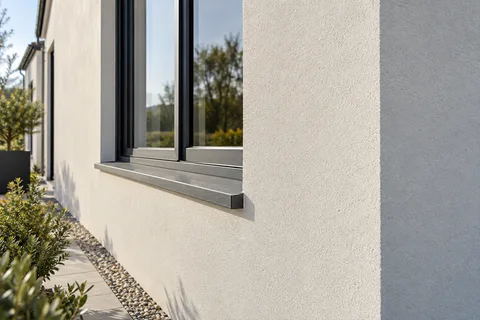
Monocouche (French for one layer) is a cement-based render with its colour mixed through, applied in a single thick coat and scraped back to a fine texture once it has partly set. Because the colour is in the material rather than painted on, a chip shows the same colour underneath. Around Harrogate it suits new houses, extensions and blockwork walls; it is a poor fit for soft old stone or a wall that needs a lime finish.

On this page
What one coat actually means
Using K Rend’s K Mono as an example, its data sheet describes spraying the render onto the prepared wall to 17 to 18 mm, levelling it straight away with a straight edge, then waiting 3 to 24 hours, depending on the wall and the drying conditions, before scraping. Scraping removes the surface skin and should leave at least 15 mm of render. K Rend says the product can go on up to 25 mm in one pass, depending on the background.
One coat is not one visit. The wall still has to be prepared, beaded and masked beforehand and protected afterwards, and a large wall needs a planned sequence so every part is scraped at the right moment.
- Background Usually blockwork or brick; uneven or mixed walls may need a levelling coat.
- Beads and mesh Beads at corners, reveals and the base; mesh over junctions and lintels.
- Monocouche passes One through-coloured material, applied in passes to the specified thickness.
- Scraped surface Scraped once partly set, which removes the skin and leaves the texture.
Wall on the left, finish on the right. Not to scale: coats, thicknesses and primers follow the chosen manufacturer’s system and the condition of the wall.
Where it fits on a Harrogate house
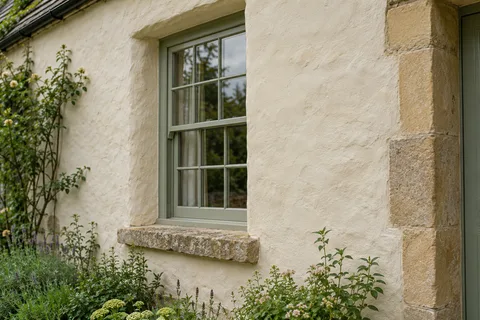
K Rend describes K Mono as a one-coat finish over most moderate to low strength blockwork, and lists its scraped range for brick, sand-and-cement render and concrete with the right preparation or base coat. That makes it a practical choice for a modern extension on the back of a stone villa, a new-build house or a later brick or block house being refaced. It is less suited to an older solid wall of soft stone or brick that relies on drying through its surface; SPAB’s advice is that dense cement-based render on such walls traps moisture.
Some owners like ashlar lines cut into the render to echo stone. K Rend’s data sheet allows ashlar grooves cut after scraping, provided at least 15 mm of coloured render remains behind each cut. Next to real sandstone dressings, imitation joints can look contrived, so judge a sample on the actual wall before committing to them.
Scraping, timing and colour
The texture depends on scraping at the right moment. K Rend’s guidance is that the wall is ready when a thumb no longer leaves an impression and the aggregate scrapes out cleanly without sticking to the blade. Every area must be scraped at the same stage: scraped early, the render comes out darker; scraped late, lighter. On a broad elevation the crew therefore sprays and scrapes in sections that will reach readiness together, with breaks at corners, beads or designed joints rather than mid-wall. Small areas such as reveals and quoins may be finished smooth.
Check the blockwork or brick is sound, clean and suitable.
Fix bell-cast, corner and stop beads; mask windows and doors.
Spray the render to the specified thickness and rule it flat.
Wait until it has semi-set, then scrape the whole section evenly.
Brush down, cut any ashlar lines, and protect from rain and sun.
Weather and the details that cause trouble
The data sheet’s limits are specific: no application below 5°C or above 30°C, none if frost is forecast within 24 hours, none in damp or wet conditions and none on elevations in direct sunlight. In practice that narrows the working window in winter, and on a bright summer day the work may need to follow the shade around the house.
The common faults are uneven scraping, which leaves blotchy shading; render taken down over the damp-proof course instead of stopping on a bell-cast bead; and cracks running from window corners, where stress concentrates. Sills, copings and verges need drips that throw water clear, or run-off will streak the new face within a season.
Maintenance and changing the colour later
Through-coloured render does not need painting, but it does weather. Green growth on shaded walls can be treated with a biocidal wash such as K Rend’s Algae Clean and rinsed gently. Chips can be patched, though a patch on an older wall will rarely match exactly. If the colour has faded or you want a change, coatings such as K Rend’s Colour Enhance are made for existing scraped render; once coated, the wall behaves like a painted wall and will need recoating in future.
Common questions
Can monocouche go straight onto old render?
Only if the existing surface is sound and the manufacturer lists it as a suitable background, usually with a base coat or bonding treatment first. Hollow or crumbling render has to come off, because a heavy one-coat render will not hold it in place.
See housing and planning information for Harrogate and nearby places, including the source and geography behind each figure.