Lime rendering
Lime rendering in Harrogate
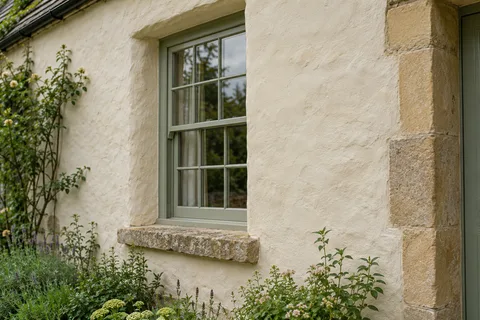
Lime render is made from lime and sand rather than cement. It is softer and more open than cement render, so a wall can take up rain and dry out again through its face, and it tolerates slight movement without cracking. In Harrogate it is the usual choice when an older sandstone or brick building that was rendered needs new render, or when hard cement render has to come off a wall that is suffering underneath it.

On this page
Why old walls and cement render fall out
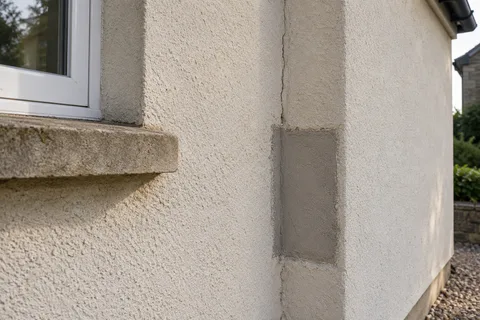
SPAB explains that older buildings rely on being permeable: moisture that gets in has to be able to evaporate. Impervious Portland cement render restricts that, and because it is more rigid than the wall it develops hairline cracks that let water in and then hold it there. The render then tends to fail in patches and come away. On a damp-looking older wall, a cracked or hollow cement render is one of the first things to check. This page deals with the render; rising damp, plumbing and ventilation are separate problems for other specialists.
The appraisal records that many buildings in High Harrogate are sandstone that has been rendered or painted. Where render on walls like these needs replacing, lime matches the way they were built.
- Stone or brick masonry Cleaned of loose material and dampened so it does not draw water out too fast.
- First (scratch) coat Often haired; scratched to give the next coat a key.
- Second (floating) coat Applied once the first has firmed up; follows the line of the wall.
- Finish coat Thin final coat, kept damp and shaded while it cures.
- Limewash or mineral paint Optional decoration that keeps the wall permeable.
Wall on the left, finish on the right. Not to scale: coats, thicknesses and primers follow the chosen manufacturer’s system and the condition of the wall.
Taking off the old render
SPAB’s advice is to remove cement render by hand with a hammer and, where needed, a chisel, testing a small area first. Levering off large sheets can pull the face off soft stone or brick. Render that is still well bonded can sometimes be left to age; removing only hollow patches, or just the base of the wall, is a recognised compromise. If the exposed wall is saturated it is given time to dry, and decayed stone or brick is made sound before any new render goes on.
How the coats go on
Lime render is built up in thin coats, each a little weaker than the one beneath. Tendring District Council’s conservation guide gives a traditional pattern of a 9 mm first coat, a 9 mm float coat and a 6 mm finish, with the earlier coats scored to key the next and the wall wetted between coats. Hollows are dubbed out first rather than filled in one go. K Rend’s K Lime range shows the same logic in bagged form: a stipple bond coat scrubbed onto dense stone or brick, a coarse mix for dubbing out, a base coat and a finer finishing coat.
Suction matters. Lime Green’s preparation guidance is to mist the wall evenly about half an hour before rendering and then test it: the surface should draw water in slowly and stay slightly damp. A wall that drinks water instantly needs more dampening; one where water runs straight off needs drying out or a stipple coat.
Remove failed or cement render by hand after a trial patch.
Rake out and repair joints and decayed stone or brick.
Mist the wall and check suction before each coat.
Dub out hollows, then apply the first coat and score it.
Apply the float coat once the first has firmed, and key it.
Apply the finish coat and texture it to suit the building.
Hang damp hessian and mist the work while it cures.
Limewash once the render has hardened.
Curing: the stage that makes or breaks lime
Lime hardens slowly, and Cornish Lime notes that rapid drying holds back the hydration and carbonation that give it strength. Its curing guide drapes hessian over new work and leaves it there for at least two weeks, and explains that wind, high temperatures and strong sunlight cause drying shrinkage, while plastic shrinkage cracks show within the first 48 hours. Tendring’s guide warns that render hit by hot sun, drying winds or frost before it sets loses adhesion and will drop off. In practice lime rendering is a spring-to-autumn job, and a scaffold wrapped in damp hessian is a sign it is being done properly.
Finishing and looking after it
SPAB regards traditional limewash as normally the most suitable finish because it keeps the wall breathable; standard modern paints are less permeable and can trap moisture, and SPAB does not advise colourless water-repellent treatments. Limewash goes on in several thin coats and is renewed as it weathers. A lime render looked after this way erodes back slowly and evenly instead of failing in sheets. In the conservation area, check with North Yorkshire Council before changing the colour of a façade, because Harrogate’s Article 4 direction brings painting under planning control.
Common questions
Is lime render weaker than cement?
It is softer by design. That lets an older wall breathe and move without cracking, and means the render, not the stone, takes the weathering. It still needs the right mix for the exposure, thin coats and careful curing.
See housing and planning information for Harrogate and nearby places, including the source and geography behind each figure.