Texture changes the way a wall reads
Smooth or textured render: how daylight changes it
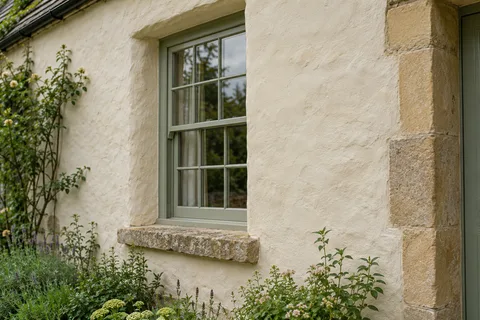
A finish that looks almost flat in a small image may show a strong grain in side light. Texture comes from the product and the way it is finished, and it decides how much of the wall’s unevenness and any joins in the work you will see. Choose it with the building and its light in mind.

On this page
What texture means for each render type
Silicone thin-coat textures are set by the grain size. K Rend’s range runs from TC05, its smoothest, through TC10 and TC15 to TC30, the number giving the largest grain in tenths of a millimetre, and the topcoat is applied only as thick as that grain before being rubbed up with a plastic float. A scraped monocouche is different again: the render is scraped after it has semi-set to remove the skin and expose the aggregate. Roughcast and pebbledash put stone on the surface; a floated sand-and-cement or lime finish depends on the float and the hand using it.
These are not interchangeable descriptions. A “smooth” silicone at 0.5 mm grain and a “smooth” floated render are different surfaces, and a scraped texture always has some relief. Ask for the product and grain or finishing method by name, and look at a real sample.
Texture also decides how easily a repair hides. Tendring District Council’s conservation guide notes that roughcast, with its coarse stony aggregate, can be applied to the ragged edges of existing render so the joint between new and old is more readily disguised. A smooth finish gives no such cover, so repairs to it are usually followed by repainting the whole elevation.
| View | Question |
|---|---|
| Close and evenly lit | Is this the intended grain? |
| From the normal approach | Does it suit the scale of the elevation? |
| In side light | How does relief affect the impression? |
| Beside retained material | Does the relationship feel deliberate? |
| At a corner | How does it continue onto a return? |
Low sun, side light and flatness
Light skimming across a wall shows up every undulation. The finer the texture, the more it reveals: a smooth or fine-grain finish on a wall with shallow hollows will show each one in low winter sun, while a coarser texture breaks the light up and disguises them. A silicone topcoat no thicker than its grain simply follows the base coat, so the wall is made flat, or not, when the base coat is ruled off.
On an older Harrogate wall the aim may not be flatness at all. Tendring District Council’s conservation guide says beads and fixed guides must not be used to artificially straighten the edges of an old wall: the render should follow the line of the building. A lime render that follows a gently irregular Victorian wall looks right in raking light; a crisp, dead-flat modern finish forced onto the same wall can look wrong.
At corners and reveals the surface changes direction and the light changes with it, so a sample that includes a corner tells you more than another flat square.
For example, take a hypothetical west-facing gable re-rendered in a fine 1 mm silicone. At noon it looks flat; on a summer evening, low sun picks out every shallow hollow left in the base coat. A 3 mm grain on the same wall would hide those hollows better but look coarser close up. The choice is a trade between finish and forgiveness, and it should be made with the base coat in mind.


Comparing finishes fairly
Words like smooth, fine and scraped cover a wide range. Ask for the product and grain by name: K Rend’s TC05 and TC30 are both silicone textures, but one has 0.5 mm grains and the other 3 mm. For a scraped render, ask to see a sample scraped by the same applicator, because the scraping shapes the finish.
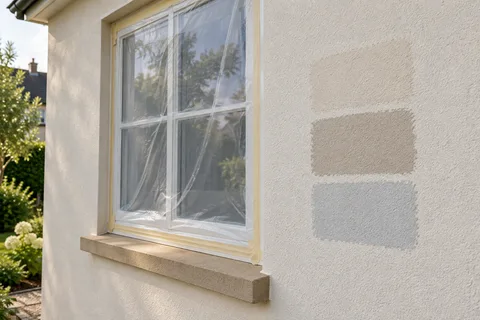
Compare one thing at a time. When choosing a texture, keep the colour the same; when choosing a colour, keep the texture the same. Otherwise a change in one is mistaken for the other.
Fix the sample upright at eye level. A board laid flat on the ground catches light from above and looks smoother and paler than the same finish on a vertical wall.
For rendering in Harrogate, the texture also has to suit the background: a fine finish needs a flat, well-ruled base coat to look right.
How texture reads across a whole elevation
Across a whole wall, texture adds up. A grain that looks lively on a small board becomes an even tone at a distance. A coarse texture makes a wall look darker and softer; a fine one makes it look lighter and sharper. Large plain walls show texture more than walls broken up by windows and bays.
Raking light, early or late in the day on east and west walls, exaggerates texture and shows any undulation. Even, overcast light flattens it. The same wall can look like two different finishes on the same day.
Older walls are rarely flat, and a new finish does not make them so unless the preparation straightens the background with a base coat or dubbing out. On an older lime-rendered wall, following the wall’s own line is often the better result.
Photographs are useful records, but zoom and screen settings change how texture looks, so decide from the real sample on the wall.
Where an older wall is meant to stay slightly irregular, a hand-floated lime render, or a coarser texture, suits it better than a fine resin finish that draws attention to every undulation.
Where texture choices cause trouble
Fine textures show joins. Stop a silicone coat mid-wall and let its edge dry, or scrape one part of a monocouche wall earlier than the rest, and the result shows as a line or a shift in shade, most of all in side light. Plan where each day’s work will stop, at corners, beads or downpipes, before the work starts.
Reveals and corners are often finished differently from the main face. The K Mono data sheet allows reveals and quoins to be left smooth, giving a crisp border to a textured wall. Decide whether you want that contrast.
Texture also affects upkeep. Dirt and algae settle into deep textures and on ledges, and a wall that looks clean when new may need a gentle biocidal wash after a few years under trees. Keep the product, grain and colour on record so repairs can be made in the same finish.
Ask to see the sample in the morning and late afternoon if the wall faces east or west, because the same texture can look almost flat at noon and strongly patterned in raking light.
See housing and planning information for Harrogate and nearby places, including the source and geography behind each figure.