A small swatch is only a starting point
Testing render colour on the wall before choosing
Colour is seen in context. A finish beside uncleaned grey sandstone, dark frames or a shaded porch reads differently from the same shade on a chart, and texture changes it again. Testing a real sample on the house, and knowing which surfaces can be coloured, avoids an expensive surprise.

On this page
Why a colour looks different on the wall
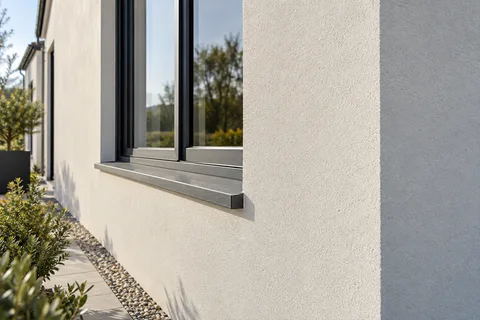
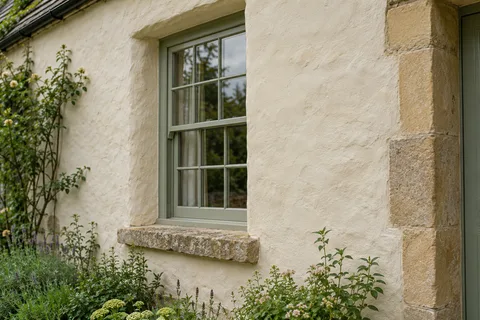
A render colour is seen through its texture. The grain of a scraped or floated finish casts tiny shadows, so the same pigment reads darker on a coarse texture than on a smooth one, and changes again as the light moves round the house. Colour also reads differently across a whole elevation than on a small chip, and against Harrogate’s stone. The 2010 appraisal says most of the town’s stone buildings have not been cleaned and present a sombre grey; a cream that looks warm on a chart can look yellow beside them.
With through-coloured render, the application affects the colour too. K Rend’s K Mono data sheet warns that scraping early gives darker shades and scraping late lighter ones, and K Rend notes slight natural shade variation between batches. For an existing wall being recoated, its current texture stays part of the result, so the sample should be painted onto the same texture rather than onto a smooth board.
| Record | What it tells you |
|---|---|
| Product, colour and grain | The actual finish being considered |
| Position beside retained materials | Its relationship to the building |
| Distant view | Its effect across a larger surface |
| Shaded view | How the apparent tone changes |
| Detail schedule | Where the colour starts and stops |
Deciding which surfaces get the colour
In Harrogate the choice of surfaces can be a planning question. The conservation-area Article 4 direction, as described in the 2010 appraisal, controls painting previously unpainted external fabric and repainting painted fabric in a different colour, with joinery and metalwork excepted. In the Duchy Estate, the appraisal lists painting façades or details such as stone surrounds among changes that spoil the symmetry of pairs of semis.
So a colour scheme needs an outline as well as a shade. Mark on a photograph which surfaces are rendered and will be coated, which stone sills, surrounds and quoins stay bare, and whether a plinth or an extension is treated differently. Recolouring render while the stone stays natural is one proposal; coating the stone as well is another, with different consequences for the building and for permission.
On a pair of semis, look at the other half before choosing. A colour that suits your house on its own can break the symmetry the appraisal values in the Duchy Estate, and the council is likely to look at the pair together.
Colour names mislead as well. K Rend’s guide notes that its White is the brightest in its scraped range but not brilliant white, that Polar White is an off-white and that its Cream has a yellow tone. Another maker’s white or cream will not match, so order from the sample, never from the name.

How to make a useful sample
Manufacturers ask for samples for good reason. K Rend recommends that all colours and textures are checked against a sample before ordering, its K Mono data sheet recommends a site sample panel, and its Silicone TC data sheet recommends a test panel to check colour and final appearance. The useful sample is made in the actual product and texture, applied the way the wall will be, and big enough to judge at a distance.
Put it where it will be seen against the materials that stay: beside a stone surround, under the eaves, next to the front door. If the elevations get very different light, try one on each. Let it dry fully before judging, because wet render and fresh paint read darker than they will finish.
Use printed cards to narrow the shortlist, then compare two or three real samples side by side. Keep the texture the same when comparing colours, and the colour the same when comparing textures, so you know which change you are reacting to.
For rendering in Harrogate, colour is one part of the wider job. Settle the repairs and preparation as well: a preferred shade does not show that the existing render is sound enough to take another coat.
What changes the look of a sample
Distance changes texture. Close up you see the grain of a scraped or floated finish; from the pavement it merges into a tone, and a coarse texture reads darker than a fine one in the same colour. Look from both distances before deciding.
Moisture and timing change colour. Fresh render and paint read darker while wet, so judge a sample only once it has dried. With through-coloured render, K Rend’s K Mono data sheet notes that scraping early gives darker shades and late lighter ones, so a sample scraped at a different stage from the wall will not match it exactly.
Light changes it again. A north-facing wall gets no direct sun; a south-facing one gets strong midday sun, and east and west walls get raking light morning or evening. A colour that suits one elevation can look flat or harsh on another, so if the house faces several ways, try the sample on more than one wall.
Phone photographs are useful for recording which sample was where, but camera processing shifts colour, so make the final decision on site.
Judge the sample in dry weather as well as after rain. Render and paint darken when wet, and a colour that reads well on a damp grey day can look much paler in summer sun.
Keeping the colour even on the day
Once a colour is chosen, the way it is applied decides whether the wall looks even. Silicone left to dry at the edge of one section before the next is joined leaves a visible line, and monocouche scraped earlier in one place than another comes out in different shades. A painted finish is usually two coats, and a second coat applied in different conditions from the first can show.
Natural breaks such as corners, downpipes and beads are where one day’s work should end. Asking where those breaks will fall on each elevation is more useful than asking for a promise that the colour will be perfect.
Record the product, colour reference and texture, and keep a labelled offcut or the sample board. Later repairs and extensions can then be matched to the original rather than to a photograph.
If the surface turns out to be in worse condition once preparation starts, revisit the decision. A coating chosen for sound render may not be the right route if substantial hollow render is found; the colour can stay, the system may change.
See housing and planning information for Harrogate and nearby places, including the source and geography behind each figure.