The building provides the evidence
Lime or a modern render system on older masonry?
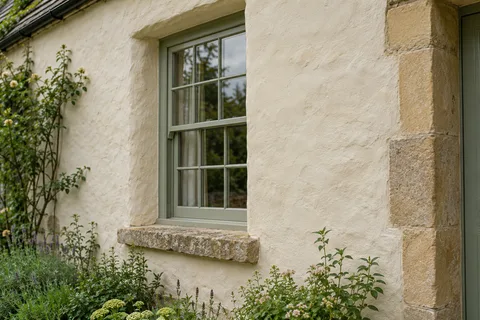
Lime and modern renders behave differently on an old wall. Lime is soft and lets moisture out through its face; cement-based and resin systems are harder and tighter. On older Harrogate sandstone and brick, which one goes on decides whether the wall can dry, so the choice follows what the wall is made of and what is already on it.

On this page
How lime and modern renders behave
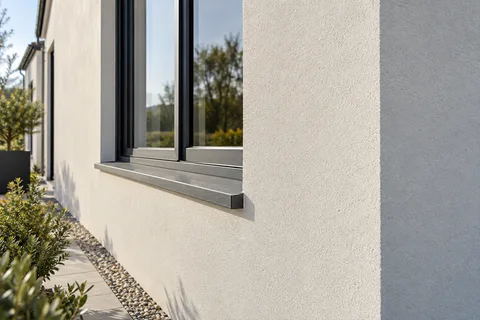
The renders differ in what they are made of and in how they handle water. Lime render is lime and sand, soft and open, built up by hand in several coats and usually finished with limewash; SPAB describes it as the usual replacement on older permeable walls because it lets absorbed water evaporate. Sand-and-cement render is harder and denser, applied as a scratch coat and a float coat and then painted. A monocouche is a cement-based, through-coloured render applied in one thick coat. A silicone system is a thin resin topcoat over a cement-based base coat; K Rend says its silicone finish repels water at the surface while allowing water vapour to pass.
So the lime-based approaches suit walls that rely on drying through their face, while a silicone system or a monocouche suits later brick and block that were built with modern mortars. The table gives the typical build-ups from the sources used on this site.
| Render | Typical build-up (source) | Usual finish | Usually suits |
|---|---|---|---|
| Lime | Three coats of about 9, 9 and 6 mm (Tendring guide) | Limewash | Older solid stone or soft brick |
| Sand and cement | Scored scratch coat and float coat | Masonry paint | Harder brick and block |
| Monocouche | One coat, at least 15 mm after scraping (K Mono) | Scraped, through-coloured | Sound blockwork |
| Silicone thin coat | 4–6 mm base coat plus 1.5–3 mm topcoat (K Rend) | Textured resin finish | Block, sound render, insulation |
What happens when cement render goes on an old wall
SPAB sets out the mechanism. An older wall takes up rain and dries out through its surface. Impervious Portland cement render slows that drying, so moisture stays in the wall. Because cement is more rigid than the masonry, it forms hairline cracks; water gets in through them and is then trapped behind the render. Tendring District Council’s guide adds the next step: trapped water can freeze, expand and blow the render off the wall, sometimes damaging the fabric beneath.
The visible results are patches of hollow render, cracks that open each winter, damp-looking areas that do not dry, and in the worst cases decay of the stone or brick behind. On a Harrogate sandstone wall that has been cement-rendered, those signs are the reason to consider removing the render and replacing it in lime.
Removal is not automatic. SPAB notes that well-bonded cement render can sometimes be left to age, and Tendring warns that stripping a fully coated wall can seriously damage the material underneath, recommending a small test patch in a discreet place first. The decision rests on what the test shows.
For example, on a hypothetical High Harrogate sandstone cottage rendered in cement some decades ago, a test patch might show the cement coming away cleanly from sound stone in one area and pulling stone faces off in another. That result could justify removing the cement where it releases cleanly and leaving well-bonded areas to age, with lime used for all the new work.

Telling what is on the wall
An older house often carries several generations of work: an original lime render patched in cement, painted more than once, with a later extension in block. Each part can be a different material even where the colour is the same, so the age of the house tells you little about any one area.
Feel and appearance give clues but not proof. Tendring District Council’s guide describes modern cements as very strong and inflexible, and lime as the softer, more flexible traditional binder; a hard, dense render is likely to contain cement, a softer and more open one may be lime. A pale colour proves nothing, because most render has been painted. Where the choice of repair depends on knowing the binder, a small sample can be taken and analysed.
Condition varies across a wall too. Render below a leaking gutter, beside a later extension or close to the ground is often wetter and weaker than the rest, and those areas usually need repair even where the rest can stay.
The Harrogate rendering guide describes each service, but on an older wall the material comes first: decide what the wall needs, then choose the work that provides it.
When a modern system is the better choice
Lime is not the answer for every wall on an old house. A later brick or block extension, a rebuilt gable in modern brick and cement mortar, or a wall that will carry external insulation are all better served by a modern system designed for that background. Putting soft lime on dense block offers no benefit and can struggle for grip without a bonding coat.
Where an old lime-rendered wall meets a new modern-rendered one, the two should not run into each other on the same plane. The render on each side stops on a bead at the junction, usually at the corner where the extension meets the house, so the different materials can move and weather independently. A painted finish over both can then give one colour without pretending they are one wall.
Paint and coatings are part of the choice. Limewash or a mineral paint goes on lime; masonry paint or a silicone coating on cement-based render. Putting an impermeable paint over new lime throws away the reason it was chosen.
Render and damp-looking walls
Owners often come to lime because a wall looks damp. Render can be part of that story in specific ways: a cement render trapping water in an older wall, cracks letting rain in, render carried down past the damp-proof course so it wicks ground moisture upwards, or failed drips and gutters soaking one area. Fixing those is render work. Tracing other causes, such as plumbing leaks, high ground levels or poor ventilation inside, is for other specialists, and a new render is not a cure for them.
A quick check helps before any decision: look at where the damp-looking areas are. If they sit below cracks, sills, gutters or along a base where render meets the ground, render detailing is a likely contributor and render work can help.
Appearance still matters once the technical route is set. Review the proposed texture, colour and edges against the building using a representative sample, and decide whether the aim is to keep the old wall’s irregularities, match an existing area or produce a more uniform finish.
Keep the written specification, product information and photographs of the wall while it was stripped. They give the next person working on it a clear starting point.
See housing and planning information for Harrogate and nearby places, including the source and geography behind each figure.